
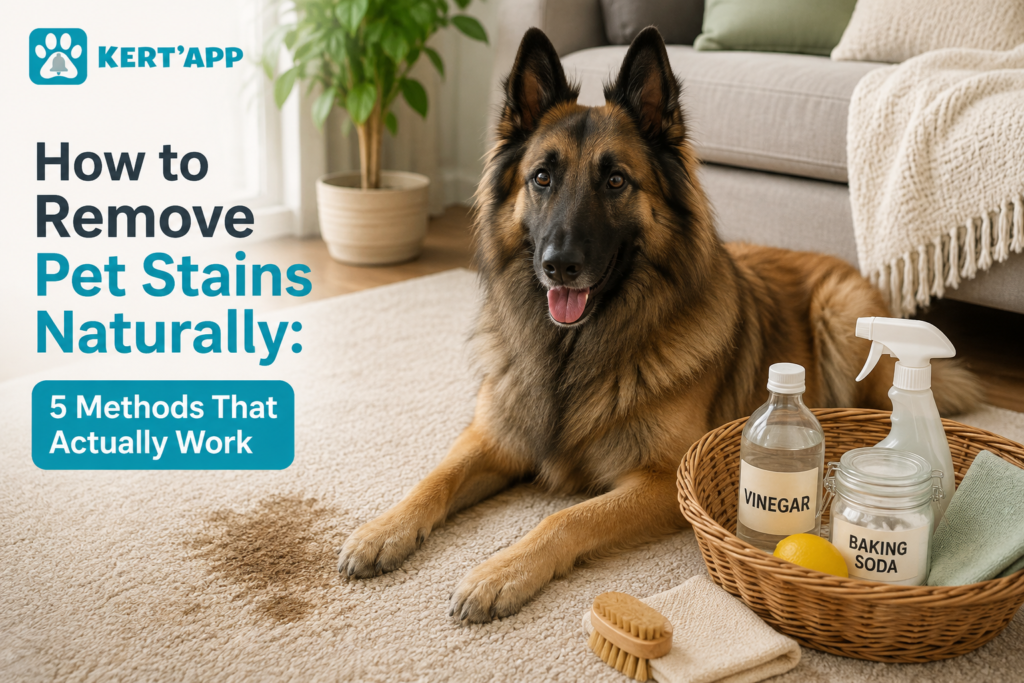
Pet accidents happen. Even a dog or cat with perfect house manners slips up now and then, and one minute you’re relaxing, the next you’re crouched over a fresh spot on the carpet trying to figure out your next move.
Here’s the reassuring part: you don’t need an expensive commercial spray or a call to a cleaning company to deal with it (though there are times a professional really is the right answer, more on that below). Vinegar, baking soda, hydrogen peroxide and the stuff already in your kitchen cabinet handles most pet stains just fine, and often better than the bottled alternatives.
This guide walks through five natural methods that consistently get results, drawn from what actually works in real households rather than marketing copy. They’re cheap, they’re safe around kids and pets, and in several cases they outperform commercial cleaners.
What you’ll learn in this guide:
- How each natural method breaks down urine at a chemical level
- Step-by-step instructions for all five approaches
- Which method fits your specific situation
- How to handle old, stubborn, set-in stains
- Ways to stop repeat accidents before they start
Key Takeaways
- For fresh stains: Enzymatic cleaner is your strongest bet. The 24-48 hour wait is worth it for the results.
- For budget-conscious quick fixes: White vinegar solution , cheap, effective, safe, and great for maintenance. Just don’t expect perfection on old stains.
- For stubborn, old stains: Hydrogen peroxide and baking soda. This is the combo for discoloration specifically.
- For odor elimination: Baking soda layering, applied after any primary method, to make sure the smell is truly gone.
- For washable items (rugs, mattress covers): Enzymatic washing powder, soaked thoroughly.
- For surface-specific materials: Hardwood needs minimal liquid (paste only). Upholstery needs enzymatic cleaner with low liquid. Mattresses need enzymatic treatment plus extensive air drying. Grout needs peroxide and baking soda scrubbing.
- For cat urine: Lead with enzymatic cleaner , cat urine’s higher chemical concentration calls for more aggressive treatment than dog urine.
- Cost comparison: Natural methods run under $10 total, often just a few dollars. Commercial pet stain removers cost $10-30 per bottle, and you may need more than one. Professional cleaning runs $75-800 depending on severity.
- Reality check: Some very old, deeply set stains won’t disappear completely , that’s a genuine material limit, not a failed effort.
Quick Method Comparison: Which Should You Use?
| Method | Best For | Time Required | Cost | Effectiveness | Difficulty |
| Enzymatic Cleaner | Fresh & old stains, odor elimination | 24-48 hours | $10-30 | ★★★★★ | Easy |
| White Vinegar Solution | Fresh stains, quick fixes, budget cleanup | 30 minutes–2 hours | <$1 | ★★★★ | Very Easy |
| Hydrogen Peroxide + Baking Soda | Old, set-in stains, discoloration | 12-24 hours | $3-5 | ★★★★★ | Moderate |
| Baking Soda + Vinegar Combo | Odor elimination, moderate stains | 4-12 hours | $2-3 | ★★★★ | Easy |
| Enzymatic Washing Powder | Washable items (rugs, mattress covers) | 4-8 hours | $5-10 | ★★★★★ | Moderate |
Why Natural Methods Actually Work for Pet Stains
Before jumping into the methods, it helps to know what you’re actually fighting. Pet urine isn’t just water with a bad smell; it carries urea, urochrome (the pigment responsible for that yellow tint), and uric acid. These compounds crystallize and lock onto carpet fibers, which is exactly why blotting with plain water never seems to do much.
If you want to know how to remove pet stains naturally without reaching for a bottled cleaner, it comes down to chemistry, not folklore. Enzymatic cleaners contain proteins that physically digest those organic compounds. Hydrogen peroxide and vinegar rely on oxidation and acid neutralization. Baking soda absorbs moisture and neutralizes odor at the source. Each one attacks a different part of the problem, which is why combining them often beats using just one.
Commercial cleaners lean on the same underlying chemistry; the difference is they’re frequently loaded with harsh additives that hang around long after the stain is gone. Go the natural route and your pets aren’t breathing in fumes, your kids aren’t picking up residue while playing on the floor, and you’re not adding to your household’s chemical footprint.
There’s also a practical upside: if you’ve got a pet that’s accident-prone, you’ll be doing this more than once. Household staples cost pennies compared to what you’d spend restocking commercial sprays.
Fresh Pet Stain: The 5-Minute Protocol
Caught your pet mid-accident, or found it seconds later? Move fast:
Step 1: Blot, don’t rub. Press paper towels or a cloth into the spot and lift as much liquid as you can. Rubbing pushes urine deeper into the fibers, it’s the single most common mistake people make here.
Step 2: Pick your trade-off. Need it handled right now? Go with white vinegar (5-10 minute dwell time). Can it wait? Enzymatic cleaner does a more thorough job over 24-48 hours.
Step 3: Apply generously. Cover the whole affected area, not just what’s visible, urine spreads well beyond the surface stain.
Step 4: Set a timer and walk away. Skipping the dwell time is the second most common mistake. Chemistry needs that time to actually work.
Step 5: Blot or extract. Once the dwell time’s up, lift the solution with paper towels or a carpet extractor.
Result: Follow this protocol on a fresh stain with any of the five methods below and you’re typically looking at 90-100% removal.
Understanding Ingredient Chemistry: How Each Method Breaks Down Urine
| Ingredient | Active Agent | How It Works | Best Against | Limitations |
| Enzymatic Cleaner | Protease enzymes | Digests protein/organic matter at molecular level | Fresh & old stains, odor | Needs moisture & time; expensive |
| White Vinegar | Acetic acid | Oxidizes ammonia compounds, neutralizes alkalinity | Ammonia-based odors | Can’t lift old discoloration; vinegar smell initially |
| Hydrogen Peroxide (3%) | Oxidation reaction | Breaks ammonia-nitrogen bonds; bleaches pigments | Old stains, discoloration, yellowing | Potential bleaching on light carpets; doesn’t address odor as well |
| Baking Soda | Alkaline base + absorption | Neutralizes odors & absorbs moisture | Lingering smells, moisture | Doesn’t remove stains; must be vacuumed completely |
| Dish Soap | Surfactant + degreaser | Helps solution penetrate fibers; breaks down oils | Spreading treatment deeper; fiber protection | Secondary role only; needs other agents |
Key insight: No single ingredient handles everything on its own. Layering methods hits the stain from multiple angles, which is exactly why professional cleaners rarely rely on just one product.
Method 1: Enzymatic Cleaners (The Most Effective Overall)
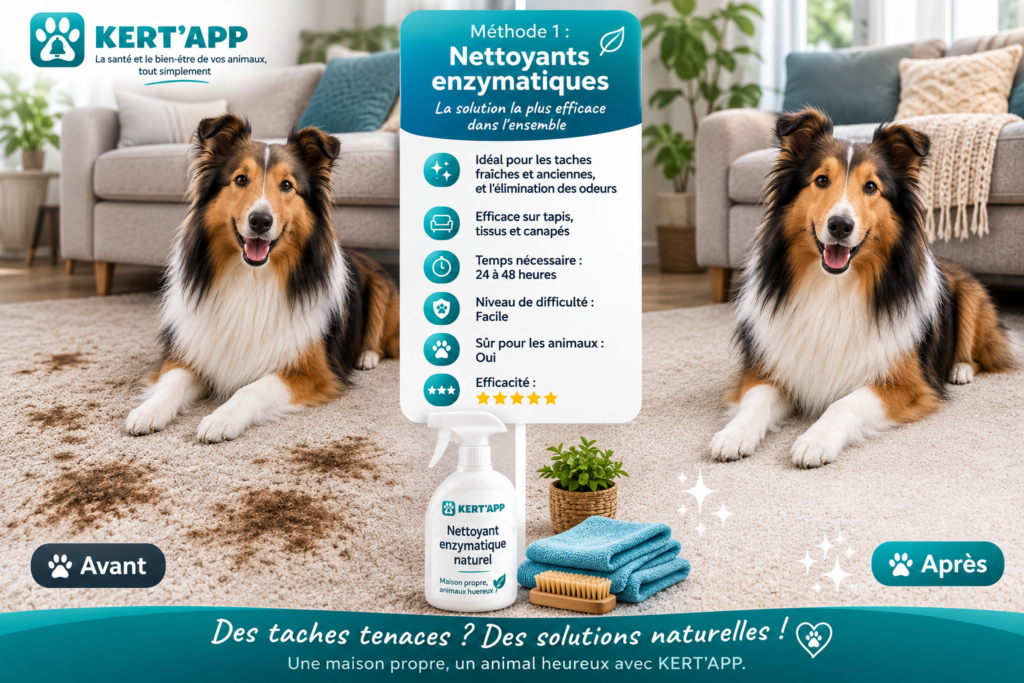
Quick Summary: Best For: fresh & old stains, odor elimination ·
Works On: carpet, fabric, upholstery ·
Time Needed: 24-48 hours ·
Difficulty: Easy ·
Pet Safe: Yes ·
Effectiveness: ★★★★★
Enzymatic cleaners earn their reputation as the gold standard for a reason. They don’t cover up odors, they eliminate the source by digesting the protein in urine at a molecular level.
Ask around among pet owners dealing with anything from puppy accidents to senior dog incontinence, and enzymatic cleaners like Nature’s Miracle come up again and again. That’s not marketing, the biological enzymes actively break down organic matter, so there’s nothing left over for bacteria to feed on and turn into ongoing odor.
What you need:
- Enzymatic cleaner (Nature’s Miracle is widely recommended, though store-brand versions work similarly)
- Paper towels or cloth
- Spray bottle
- Plastic wrap or foil (optional, keeps the area moist)
Step-by-step process:
- Blot fresh urine immediately. Absorb as much moisture as you can with paper towels or cloth. Press firmly, don’t rub, since that spreads urine deeper into the fibers.
- Apply the enzymatic cleaner generously. Saturate the area fully. The enzymes need moisture to activate, so follow the product’s dilution instructions if it calls for any.
- Let it sit. This step matters more than people expect. The enzymatic reaction needs 24-48 hours to fully break down the compounds, long, yes, but it’s the reason this method works so well.
- Boost the reaction (optional). Covering the spot with plastic wrap traps moisture and speeds up the enzyme activity.
- Extract or vacuum. Once the dwell time’s up, use a carpet extractor if you have one, or vacuum once it’s fully dry.
- Repeat if needed. Old, stubborn stains sometimes need a second round.
Expected results: Fresh stains generally disappear completely. Old stains improve noticeably, though very set-in ones may need more than one treatment.
Cost: $10-30 per bottle, but one bottle typically covers several stains.
Method 2: White Vinegar Solution (The Quick, Budget Option)
Quick Summary: Best For: fresh stains, quick fixes, budget cleanup ·
Works On: carpet, upholstery, floors ·
Time Needed: 30 minutes–2 hours ·
Difficulty: Very Easy · Pet Safe: Yes ·
Effectiveness: ★★★★
Vinegar is acidic, and that acidity neutralizes the alkaline compounds in urine. It also disrupts the odor-causing bacteria and enzymes lingering in the stain.
The chemistry is refreshingly simple: acetic acid, the active ingredient in vinegar oxidizes ammonia compounds in pet urine. It’s not masking the smell; it’s actually neutralizing it. This is also why vinegar shows up constantly in pet-owner communities like r/LifeProTips and r/carpetcleaningporn as the go-to first response.
What you need:
- White vinegar (regular household vinegar)
- Water
- Spray bottle
- Paper towels or cloth
- Vacuum
Step-by-step process:
- Mix the solution. Combine white vinegar and water in a 1:2 ratio one part vinegar, two parts water. That’s strong enough to work without risking damage to your fibers.
- Blot the fresh urine first. Pull up as much moisture as possible with paper towels.
- Spray generously. Fully saturate the affected area.
- Let it sit for 5-10 minutes. This gives the vinegar time to neutralize the ammonia and break down the urine compounds.
- Blot again, don’t rub. Keep blotting with a clean cloth or paper towels until the area feels mostly dry.
- Rinse with plain water. Skippable, but a light rinse prevents any sticky vinegar residue. Spray lightly and blot once more.
- Air completely dry. Open a window or point a fan at it to speed things along.
- Vacuum once fully dry.
About the smell: Yes, it’s noticeable right after application. But vinegar’s odor is volatile and fades fast as it dries. Most people notice it’s gone within a couple of hours. And whatever lingers is nothing compared to what pet urine smells like if left untreated.
Expected results: Excellent on fresh and moderately aged stains. Older, set-in stains improve but might not vanish entirely after just one application.
Cost: Pennies. A bottle of white vinegar runs under $3 and handles dozens of accidents.
Method 3: Hydrogen Peroxide and Baking Soda Mix (The Power Combo)
Quick Summary: Best For: old, set-in stains, discoloration
Works On: carpet, medium/dark fibers ·
Time Needed: 12-24 hours
Difficulty: Moderate
Pet Safe: Yes (test light carpets first)
Effectiveness: ★★★★★
This pairing tackles stains from two directions at once. Hydrogen peroxide breaks down ammonia-nitrogen compounds through oxidation, while baking soda neutralizes odor and helps lift discoloration.
Pet care forums and professional cleaners alike point to this combination as one of the most reliable options for old, stubborn stains. Rather than dissolving or masking the compounds in urine, the reaction actually breaks the chemical bonds holding them together.
What you need:
- 10 ounces of 3% hydrogen peroxide (standard drugstore strength)
- 3 tablespoons of baking soda
- 3-4 drops of dish soap
- Spray bottle (or apply with a cloth)
- UV flashlight (optional, but useful for spotting old stains)
Critical safety note: Never combine hydrogen peroxide with ammonia-based cleaners , or urine itself, which contains ammonia. That reaction produces toxic chlorine gas. Never mix with bleach, under any circumstances. Stick strictly to peroxide, baking soda, and dish soap , that combination is safe.
Step-by-step process:
- Find the stains with UV light (optional but recommended). Old urine spots that have faded to the eye still glow under UV, which makes them easy to track down , especially useful for spots that no longer look stained but still smell.
- Mix your solution. Pour the hydrogen peroxide into a bowl, stir in the baking soda , it’ll fizz , and add the dish soap so the mixture spreads and penetrates the fibers.
- Apply to the stain. Pour directly onto the spot or work it in with an old cloth, saturating the full area.
- Let it work. The fizzing continues for 5-10 minutes as the reaction breaks down the urine compounds. Leave it alone during this step.
- Blot and let dry. Once the fizzing stops, blot with paper towels , don’t rub , and let it air dry fully, which can take 12-24 hours.
- Vacuum thoroughly once dry.
A note on carpets: Test on a hidden patch first if your carpet is light-colored. Hydrogen peroxide at 3% is usually safe, but it can lighten very pale fibers. Dark and medium tones typically have nothing to worry about.
Expected results: This method shines on old, set-in discoloration. Staining usually lightens significantly and the odor generally disappears altogether.
Cost: Under $5 total, and the ingredients stretch across multiple stains.
Method 4: Baking Soda and Vinegar Two-Step (The Layered Approach)
Quick Summary: Best For: odor elimination, moderate stains
Works On: carpet, rugs ·
Time Needed: 4-12 hours ·
Difficulty: Easy · Pet Safe: Yes ·
Effectiveness: ★★★★
Applied one after another, vinegar’s oxidizing power and baking soda’s absorbing, odor-neutralizing properties work as a tag team , the combination penetrating deeper into carpet fibers than either ingredient manages alone.
What you need:
- White vinegar
- Baking soda
- Water
- Spray bottle
- Cloth or paper towels
- Vacuum
Step-by-step process:
- Apply the vinegar solution first. Use the same 1:2 vinegar-water mix from Method 2. Spray thoroughly and let it sit for 5-10 minutes.
- Blot the vinegar solution. Pull up as much moisture as you can.
- Sprinkle baking soda generously. Cover the whole affected area with a solid layer , don’t skimp here.
- Let it sit for several hours, or overnight. The baking soda absorbs leftover moisture and neutralizes odor, which is where this method really earns its place.
- Vacuum thoroughly. Run your vacuum on its strongest setting, and expect to go over the area more than once to get all the powder up.
- Optional final rinse. A light spray of plain water afterward can rinse away any residue. Let it dry, then vacuum again.
Expected results: Very strong for odor elimination. Stain removal is solid, though Methods 1 and 3 typically outperform this one specifically for discoloration.
Cost: Pennies , both ingredients are already household staples.
Method 5: Enzymatic Washing Powder for Washable Items (For Mattresses, Rugs, and Furniture)
Quick Summary: Best For: washable items, deep saturation ·
Works On: rugs, mattress covers, cushion covers ·
Time Needed: 4-8 hours ·
Difficulty: Moderate ·
Pet Safe: Yes ·
Effectiveness: ★★★★★
When urine soaks past the carpet into the padding, or into a mattress or upholstered cushion, spot treatment isn’t enough , you need a full soak. Biological or enzymatic washing powders contain enzymes that break down organic matter at scale, across the whole item rather than just the surface.
This approach comes up often in r/CleaningTips threads from people dealing with serious saturation , including at least one owner whose cats soaked clean through a cushion.
What you need:
- Biological or enzymatic washing powder/detergent
- White vinegar (optional)
- Baking soda (optional)
- Large basin or bathtub
- Warm water
- Clothesline or open area for air drying
Step-by-step process:
- Soak the item if possible. For removable mattress covers, rugs, or cushion covers, soak in warm water mixed with enzymatic washing powder, following the powder’s dilution instructions.
- Let it soak for 4-8 hours, or overnight. The enzymes need extended contact time to work through urine compounds spread across the fabric.
- Rinse thoroughly. Clean, running water should flush out the soap and any dissolved urine , rinse more than once for a truly clean result.
- Optional secondary treatment. For stubborn items, add vinegar to the rinse water (1:2 ratio) and rinse again, then follow with a baking soda soak for extra odor absorption.
- Air completely dry. This step is non-negotiable , incomplete drying invites mold and mildew. Lay flat or hang in sunlight when you can; UV exposure helps kill bacteria and cut down odor.
For items you can’t remove (like mattresses): Mix the enzymatic powder into a paste with water, apply to the affected area, let it sit for several hours, then extract with a wet vacuum or a damp cloth.
Expected results: When the item can be fully soaked, both stain and odor removal are typically excellent.
Cost: Usually $5-10 per box, with enough powder for several uses.
Surface-Specific Stain Removal: Tailored Approaches
Not everything is carpet. Here’s what to do depending on the surface.
Hardwood and Laminate Floors
The challenge: Too much moisture warps and damages wood, so treatment has to stay surface-level.
Best method: Hydrogen peroxide and baking soda , peroxide won’t harm wood as long as moisture stays minimal.
Process:
- Mix peroxide and baking soda into a paste, not a liquid
- Apply only to the stained area with a cloth
- Let sit 10-15 minutes , not hours
- Wipe immediately with a damp cloth
- Dry thoroughly with a towel right away
- Never saturate the wood
Alternative: Vinegar solution, applied with a barely-damp cloth rather than sprayed. Apply, wait three minutes, wipe dry right away.
Critical: If the wood has already soaked through or started to warp, DIY treatment won’t fix it , you’re looking at professional restoration at that point.
Upholstered Furniture and Cushions
The challenge: Urine soaks into the padding, which means you need deep treatment without drenching the fabric.
Best method: Enzymatic cleaner applied with minimal liquid, or enzymatic washing powder for removable covers.
Process for cushions:
- Use UV light to locate every affected area
- Apply enzymatic cleaner with a cloth , dab, don’t spray or soak
- Cover with plastic wrap for 24 hours
- Blot thoroughly
- Air dry fully, using fans to speed things up
For removable covers: Method 5’s enzymatic powder soak gives the best results.
Critical: Trapped moisture in upholstery padding is a mold and mildew risk. Make sure drying is complete , fans or sunlight help.
Mattresses
The challenge: Urine works its way deep into foam or springs, and mattresses are notoriously hard to extract moisture from.
Best method: Enzymatic cleaner with minimal liquid, followed by extensive air drying.
Process:
- Locate every urine spot with UV light
- Apply enzymatic cleaner with a cloth only , avoid heavy spraying
- Let sit 12-24 hours without oversaturating
- Blot aggressively with towels
- Stand the mattress on its edge and run fans for 48+ hours
- Place in direct sunlight if you’re able to
- For severe saturation, use a wet/dry vacuum to pull out excess moisture
For future prevention: A waterproof mattress pad keeps urine from ever reaching the mattress , much easier than treating it after the fact.
Reality check: A deeply soaked mattress sometimes can’t be fully saved. If the smell won’t budge after thorough treatment, replacement may be the more sensible option.
Grout and Tile
The challenge: Porous grout soaks up urine odor, and the compounds hide in the grout lines where they’re easy to miss.
Best method: Hydrogen peroxide (kills bacteria) paired with baking soda (absorbs odor).
Process:
- Clean the tile surface first with a regular cleaner
- Apply hydrogen peroxide directly to the grout lines
- Sprinkle baking soda over the peroxide , it will fizz
- Let sit 15-20 minutes
- Scrub the grout lines with an old toothbrush
- Rinse thoroughly with water
- Dry completely
Prevention: Seal grout annually to keep it from soaking up odor in the first place.
Car Interiors
The challenge: Tight spaces, hard-to-reach padding beneath seats, and odor that concentrates in an enclosed cabin.
Best method: Enzymatic cleaner (liquid formula), backed up with enzymatic powder for deeper padding.
Process:
- Locate the urine spot with UV light
- Apply enzymatic cleaner generously
- Cover with plastic to hold in moisture for 24 hours
- Crack the windows slightly so humidity doesn’t build up
- After 24 hours, blot thoroughly
- Leave the windows open and place baking soda under the seat for extra odor absorption
- For persistent smell, tuck a bowl of baking soda or crumpled newspaper under the seat overnight
Prevention: Removable, washable pet car seat covers save a lot of future hassle.
Cat Urine vs. Dog Urine: Key Differences
Not every accident is the same fight. Cat and dog urine call for slightly different approaches.
Why Cat Urine Smells Worse
Cat urine carries higher concentrations of urea, creatinine, and uric acid than dog urine does. That chemical makeup makes it:
- Significantly more pungent
- More prone to crystallizing deep into fibers
- More resistant to odor elimination
- More likely to trigger repeat marking in the same spot
The cat problem: Cats can detect old urine spots long after humans have stopped noticing anything. That lingering scent tends to trigger more marking, which is how the cycle keeps going.
Treatment Differences
For dog urine (generally easier):
- Most methods work well
- Fresh accidents respond quickly to vinegar
- Old stains respond well to enzymatic cleaner
- Odor is usually eliminated completely
For cat urine (needs more intensity):
- Start with enzymatic cleaner rather than vinegar alone
- Use UV light aggressively , cats often mark the same general area multiple times
- Consider the hydrogen peroxide + baking soda combo for stubborn spots
- Don’t skip the baking soda step for odor
- Expect to sometimes need multiple treatments even once you can’t smell anything, since cats detect lower odor concentrations than we do
Detection: Finding Hidden Cat Accidents
Cats mark strategically. Check:
- Corners of rooms (territorial marking)
- Soft surfaces (their preferred material)
- Under furniture, where they tend to hide
- Areas near the litter box, if it’s not being kept clean (a signal they want a better option)
- Your bed (often a sign of stress or an underlying health issue so you can try health tracer app , worth a vet visit)
Run UV light systematically through the whole house, not just the spots you already suspect.
Dealing with Old, Set-In Stains
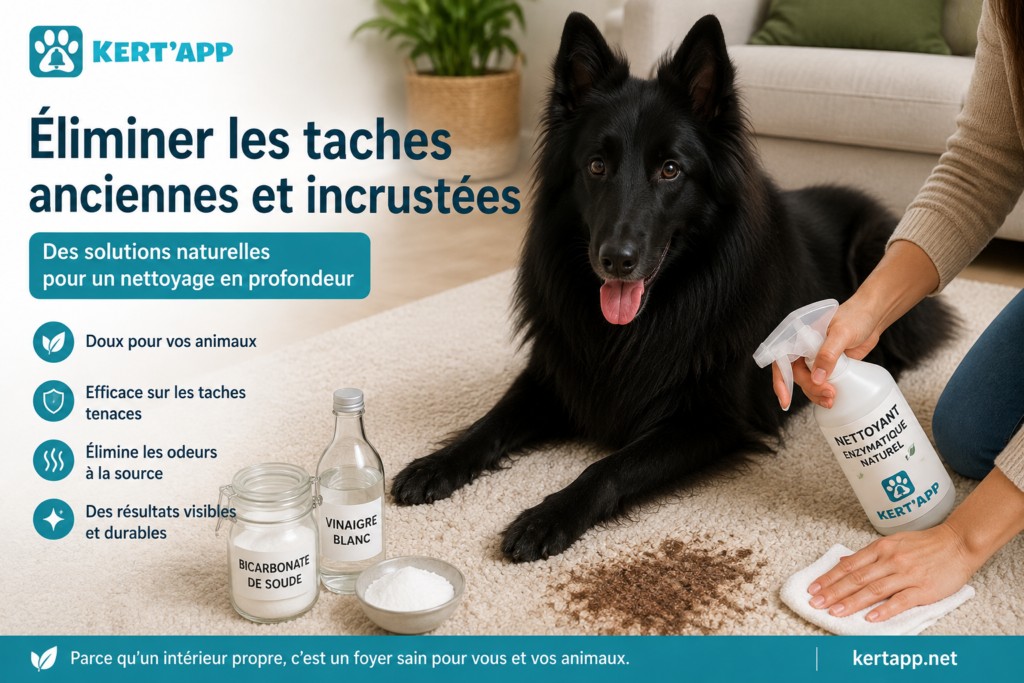
Old stains are stubborn because the compounds in urine have crystallized and bonded deeply with the fibers. A lot of people run into trouble here simply because they try a method once, expect perfection, and give up when it isn’t fully clear. Set-in stains often need repeat treatment or a combination approach.
What actually works for old stains:
- Start with UV light detection. Confirm you’ve found every problem area , some old accidents aren’t visible to the naked eye at all.
- Try the hydrogen peroxide and baking soda combo first. This is your strongest option for tackling old discoloration.
- If that doesn’t finish the job, follow with enzymatic cleaner. Running both methods in sequence often succeeds where either one alone falls short.
- Consider professional cleaning. Sometimes urine has soaked past the carpet into the backing and padding. At that point, professional equipment with heat and extraction outperforms anything you can do at home.
When to Call a Professional: Cost Comparison and Decision Guide
DIY covers most situations, but sometimes bringing in a professional is the smarter move, both practically and financially.
When Professional Cleaning Makes Sense
Call a professional if:
- The accident soaked deep into the padding or subflooring (a persistent smell after surface cleaning is the giveaway)
- You’ve already tried multiple DIY methods and the smell won’t go away
- You have a valuable carpet you’d rather not risk
- The stain covers a large area , more than 50 square feet
- You want professional-grade hot water extraction equipment
- The padding underneath the carpet is saturated (this needs professional-level moisture removal)
Cost Comparison
DIY method costs:
- Enzymatic cleaner: $10-30 (covers multiple stains)
- Hydrogen peroxide + baking soda: $3-5
- Vinegar solution: <$1
- Total for a full home treatment kit: $15-35
Professional cleaning costs:
- Spot treatment: $75-150
- Full room cleaning: $150-400
- Whole house: $300-800
- Specialized odor removal: an additional $75-200
Why Professional Equipment Wins for Deep Saturation
Professional cleaners bring:
- Hot water extraction at 200°F+ (which kills bacteria and breaks down compounds far better than cold water)
- Suction power that pulls out moisture more completely than any home method can
- Enzyme treatments applied under controlled conditions with optimal timing
- Moisture detection equipment to confirm nothing is left behind
For surface stains and fresh accidents, DIY genuinely gets the job done. For deep saturation that’s reached the padding and subfloor, professional equipment is what actually solves it.
Prevention: Stop Accidents Before They Happen
Prevention beats cleanup every time. Here’s what actually cuts down on repeat accidents:
Identify problem areas. UV light will show you every affected spot. Pets tend to return to the same area because they can still smell their last accident , miss a spot, and your pet will find it before you do.
Clean thoroughly, right away. Fresh accidents are far easier to treat than old ones. Every hour that passes makes the job harder.
Address the underlying issue. Repeated accidents usually have a cause:
- Urinary tract infections or other medical issues (worth a vet visit)
- Anxiety or stress
- Territorial marking behavior
- Age-related incontinence
- Limited access to the outdoors
- A dirty litter box (especially for cats)
Consider protective measures:
- Washable pet pads in problem-prone areas
- Enzyme-based deterrent sprays to discourage re-marking
- Keeping treated areas clean so residual scent doesn’t invite a repeat
- Mattress protectors and furniture covers
- A consistently clean litter box (for cats)
Medical considerations: If a pet that’s always been reliably house-trained suddenly starts having accidents, call your vet. That kind of change often points to:
- A urinary tract infection (especially common in cats)
- Diabetes
- Kidney disease
- Cognitive decline in older pets
- Incontinence tied to age or medication
Sometimes an accident isn’t a behavior problem at all , it’s medical. A vet visit can pinpoint the cause and prevent future incidents in a way no cleaning method can.
Frequently Asked Questions
Does vinegar really remove pet urine smell?
Yes. Vinegar’s acetic acid neutralizes the ammonia compounds in pet urine, addressing the source of the odor rather than covering it up. It works best on fresh urine, though , for old, set-in odors, enzymatic cleaners or baking soda layering perform better.
How long does it take to remove pet stains naturally?
Fresh stains can clear up within 24-48 hours using enzymatic treatment. Old stains often need multiple treatments spread across several days. Very set-in stains may take weeks of repeated treatment, or might not fully disappear. The longer a stain sits before treatment, the longer it takes to remove.
Will vinegar smell go away after drying?
Yes, completely. Vinegar’s odor is highly volatile and dissipates quickly as it evaporates , usually within 2-4 hours, faster with open windows. Whatever smell lingers is far preferable to untreated pet urine, which doesn’t fade on its own.
Is hydrogen peroxide safe for colored carpets?
3% hydrogen peroxide (drugstore strength) is generally safe on medium to dark carpets. Test a hidden area first if your carpet is very light or pale. If you’re unsure, vinegar is the safer choice and still effective. Never skip the hidden-area test on visible carpet.
Can I mix vinegar and hydrogen peroxide?
No. Combining them creates peracetic acid, which is corrosive and can damage both carpet fibers and skin. If you want to use both, apply them sequentially , vinegar first, then hydrogen peroxide separately after a thorough rinse , but never mix them together.
What’s the difference between enzymatic cleaners and hydrogen peroxide?
Enzymatic cleaners use biological enzymes to digest organic matter directly. Hydrogen peroxide relies on chemical oxidation to break the compounds down. Enzymatic treatment is slower but often more thorough; hydrogen peroxide works faster but may not reach as deep into very old stains. For tough, old stains, using both in sequence gets the best results.
Can I combine multiple methods?
Yes , and it often works better than relying on one. A common sequence is vinegar first to neutralize ammonia, enzymatic cleaner next, then baking soda to finish off any odor. Space each step out by a few hours so every method has time to actually work.
Why doesn’t my carpet smell improve even after cleaning?
A few possibilities: you missed some urine spots (UV light will catch what your eyes can’t); the urine has already soaked into the padding or subflooring, so surface cleaning alone won’t reach it; drying time wasn’t long enough (moisture is exactly what bacteria need to keep producing odor); or the carpet backing is saturated and needs professional extraction. If the smell persists after real DIY effort, professional cleaning is usually the next step.
Conclusion
Pet stains are annoying, but they’re genuinely treatable with things you probably already have at home. Enzymatic cleaners give the most reliable results for serious stains. Vinegar handles quick, budget-friendly cleanup. Hydrogen peroxide takes on old, stubborn discoloration. Baking soda finishes the job by clearing out lingering odor. Each one has its place in the toolkit.
The real skill is matching the right method to your situation , fresh versus old stain, carpet type, how bad the smell is, the surface involved, and what you’re willing to spend.
Pick the method that fits, give it the time it needs (patience really does matter here), and don’t be afraid to combine approaches when one alone isn’t cutting it. Most accidents can be fully resolved for a few dollars’ worth of household items.
Your carpet doesn’t have to carry the evidence of every pet accident forever. Handled right, it’ll look and smell like nothing ever happened.
Talk to your vet about what’s most common in your area, what fits your dog’s lifestyle, and whether a combination product makes sense for your household. It’s a short conversation that heads off a much longer and more expensive one down the line.
Tracking medication dates, vet visits, and test results is a lot easier when it’s all in one place instead of scattered across sticky notes and old texts.