
If you’ve ever stood in front of your dog’s food bowl wondering whether you’re pouring too much kibble or not enough, you’re definitely not alone. Pet obesity has reached epidemic proportions,recent data shows that over 56% of dogs in the United States are overweight or obese, according to veterinary surveys. Yet plenty of dog owners unknowingly underfeed their pups too, leading to malnutrition and energy deficiencies.
Here’s the thing: feeding your dog isn’t one-size-fits-all. Just like humans don’t all need the same daily calories, neither do dogs. A 30-pound active Labrador needs a completely different amount of food than a sedentary 30-pound Bulldog. Your dog’s weight matters, but it’s only part of the equation.
This guide walks you through everything you need to know about feeding your dog based on weight, age, activity level, and individual needs. We’ve compiled recommendations based on AAFCO standards, veterinary research, and practical feeding strategies that work in real homes.
Understanding Your Dog’s Daily Caloric Needs
Before we talk about portions, let’s cover the basics. Every dog needs a certain amount of calories daily to maintain body weight, support metabolic functions, and fuel activity. The challenge? That number varies wildly between individual dogs.
Most dogs need somewhere between 25 to 35 calories per pound of body weight per day. A 50-pound dog, for example, might need 1,250 to 1,750 calories daily,but this depends entirely on your specific dog’s situation.
Think of calories like your dog’s fuel tank. An overweight senior dog lounging on the couch all day? Bottom of the range. A working Border Collie herding sheep eight hours a day? Top of the range. Your regular family dog getting a couple of walks daily? Somewhere in the middle.
Why Weight Matters in Feeding Decisions
Your dog’s weight is the foundation of the feeding equation. It tells you their baseline caloric needs. But here’s what many dog owners miss: you shouldn’t just follow what’s printed on the kibble bag.
Those recommended portions on pet food bags? They’re ballpark figures for an “average” dog. Since no dog is truly average, the bag is usually a starting point, not gospel. Some dogs need less, others need more. It’s your job to adjust based on how your individual dog responds.
The math behind it’s pretty straightforward. According to research published through veterinary nutrition databases, you multiply your dog’s weight by 25-35, depending on their activity level and metabolism. A more active dog sits at the higher end. A less active dog sits at the lower end.
Factors That Affect Your Dog’s Calorie Needs
Weight is the beginning, but several other factors dramatically change how much your dog should actually eat:
Activity Level – This is huge. An active dog burns significantly more calories than a sedentary one. It’s the difference between a dog that goes on three walks a day versus one that mostly rests indoors.
Age – Puppies burn calories faster due to growth and constant activity. Senior dogs typically need fewer calories because their metabolism slows down, though some older dogs still maintain high activity levels.
Metabolism – Just like people, some dogs are naturally faster or slower burners. You might have two Beagles of identical weight and age, yet one stays lean while the other gains weight on the same portions.
Health Status – Dogs with health conditions might need fewer calories (like those dealing with weight management issues) or more nutrients distributed differently (like dogs recovering from surgery).
Coat and Body Condition – How your dog looks and feels matters more than the scale. You should be able to feel their ribs easily but not see them prominently.
How Much to Feed a Dog by Weight: The Essential Chart
Let me give you the practical reference table most dog owners actually need. This assumes a dog with moderate activity (regular walks, playtime, indoor rest).
Small Breed Dogs (5-25 lbs):
- 5 lbs: 125-175 calories daily
- 10 lbs: 250-350 calories daily
- 15 lbs: 375-525 calories daily
- 20 lbs: 500-700 calories daily
- 25 lbs: 625-875 calories daily
Medium Breed Dogs (26-50 lbs):
- 30 lbs: 750-1,050 calories daily
- 40 lbs: 1,000-1,400 calories daily
- 50 lbs: 1,250-1,750 calories daily
Large Breed Dogs (51-100 lbs):
- 60 lbs: 1,500-2,100 calories daily
- 75 lbs: 1,875-2,625 calories daily
- 90 lbs: 2,250-3,150 calories daily
- 100 lbs: 2,500-3,500 calories daily
Giant Breed Dogs (100+ lbs):
- 110 lbs: 2,750-3,850 calories daily
- 130 lbs: 3,250-4,550 calories daily
- 150+ lbs: 3,750-5,250+ calories daily
These calculations assume an average kibble with around 350-400 calories per cup. Most commercial dog foods range from 300-500 calories per cup depending on protein and fat content, so check your bag’s specific calorie statement.
Why One-Size-Fits-All Feeding Doesn’t Work
Here’s something most dog food bags won’t tell you: their recommended portions work for maybe 60-70% of dogs. The rest need adjustments.
This is where body condition scoring comes in. Your vet probably uses a 1-9 scale or 1-5 scale to assess whether your dog is at a healthy weight. At home, you’re checking for the rib test. Can you feel your dog’s ribs when you gently press their sides? You should be able to feel them without seeing them protruding.
If your dog is getting chunky, you reduce portions. If they’re getting too thin, you increase them. It’s not rocket science, but it requires actual observation of your individual dog rather than blind faith in bag recommendations.
Some dogs also have faster or slower metabolisms,what’s sometimes called individual variation in metabolic rate. A Corgi and a Border Collie might weigh the same but have completely different caloric needs. One might maintain weight on 1,000 calories while the other needs 1,400.
Puppy Feeding Guide by Weight and Age
Puppies are a different beast entirely. They’re not just small adults,they’re growing machines that need different nutrition and more frequent meals.
| Life stage | Feeding frequency | Calories per lb/day | Example |
| Early puppyhood (8wk–4mo) | 3–4 meals/day | ~2x adult rate (per-meal, not per-lb) | 5 lb pup: 150–200 cal/meal; 20 lb pup: 400–500 cal/meal |
| Puppy 4–12mo, small breed (<25 lb adult) | 2 meals/day | 40–50 cal/lb | 10 lb pup: 400–500 cal/day |
| Puppy 4–12mo, medium breed (25–100 lb adult) | 2 meals/day | 35–40 cal/lb | 40 lb adolescent Lab: 1,400–1,600 cal/day |
| Puppy 4–12mo, large/giant breed | 2 meals/day | Conservative end of medium range, breed-specific formula | 60 lb Great Dane pup: feed low end of range, not like a 60 lb adult |
| Adult , sedentary | 1–2 meals/day | 25–28 cal/lb | 50 lb dog: 1,250–1,400 cal/day |
| Adult , moderately active | 1–2 meals/day | 28–32 cal/lb | 50 lb dog: 1,400–1,600 cal/day; 75 lb dog: 2,100–2,400 cal/day |
| Adult , highly active/working | 1–2 meals/day | 32–40+ cal/lb | 50 lb working dog: 1,600–2,000 cal/day |
| Senior (7+ yrs, est.) | 2–3 meals/day | ~20–25% less than adult rate | 60 lb dog: 1,500 cal (adult) → 1,200–1,275 cal (senior) |
Feeding Dogs: Special Breed Considerations
| Breed (EN / FR) | Typical adult weight | Daily calories (moderately active) | Cal/lb/day | Meals/day | Key consideration |
| Shetland Sheepdog / Berger des Shetlands | 15–25 lb | ~450–800 cal | 28–32 | 2 | Small-to-medium, high-energy herding breed; thick double coat can hide weight gain, so rely on the rib check rather than looks |
| Belgian Shepherd (Groenendael) / Berger Belge Groenendael | 55–75 lb | ~1,450–2,250 cal | 26–30 | 2 | Deep-chested, athletic build carries a real bloat risk — split into two meals, avoid hard exercise right before/after eating |
| Belgian Shepherd (Tervueren) / Berger Belge Tervueren | 50–75 lb | ~1,400–2,400 cal | 28–32 | 2 | Very high working/herding drive; active sport or working dogs sit at the top of this range, sedentary companions at the bottom |
Weight Loss: Feeding an Overweight Dog
If your vet has recommended weight loss for your dog, feeding strategy becomes crucial. This isn’t about harsh restriction,it’s about sustainable, healthy weight reduction.
The Safe Weight Loss Approach
Dogs should lose weight slowly,about 1-2% of their body weight per week. For a 100-pound dog, that’s 1-2 pounds weekly. This might seem slow, but rapid weight loss in dogs can cause health problems.
Start by reducing portion size by about 10%. Reassess after 3-4 weeks. If weight loss isn’t happening, reduce by another 5-10%. If weight loss is too rapid (more than 2% weekly), increase portions slightly.
Don’t cut more than 25-30% from their normal calories,that’s unsustainably low and leaves you with an unhappy, hungry dog.
Feeding Tricks for Weight Loss
Several strategies help with weight loss while keeping your dog satisfied:
Use low-calorie fillers. Add cooked green beans, pumpkin, or broccoli to kibble to increase volume without many calories. Your dog feels fuller on similar-sized portions.
Switch to lower-calorie kibble. Weight management formulas often have fewer calories per cup and more fiber to increase satiety.
Increase meal frequency. Three smaller meals often keep dogs feeling fuller longer than one large meal.
Count treat calories. Treats should be less than 10% of daily calories. If your dog is gaining weight, treats are often the culprit. Switch to nearly-zero-calorie options like green beans or plain carrots.
Increase exercise gradually. More activity creates calorie deficit, but increases slowly, especially in overweight dogs whose joints are already stressed.
Monitoring Weight Loss Progress
Weigh your dog every 2-3 weeks. Track progress on a calendar. You’re looking for consistent, slow weight loss, not rapid changes either direction.
Use body condition scoring,that rib test,more than the actual scale weight. A 60-pound dog at ideal weight should feel substantially different than a 60-pound dog that’s overweight.
Feeding Dogs with Health Conditions
Dogs with specific health issues often need modified portions or specialized diets. This is where working with your veterinarian becomes essential.
Digestive Issues and Food Sensitivities
Chronic diarrhea/vomiting are classic parasite symptoms, so this is a natural tie-in before you pivot to diet-based causes. Some do better on smaller, more frequent meals. Others do better with limited-ingredient formulas.
Your vet might recommend an elimination diet to identify problem ingredients. During this process, portions might change as you switch formulas.
Joint and Bone Health
Dogs prone to joint issues or recovering from orthopedic surgery need weight management and specific nutrients. Keeping them lean reduces joint stress. Extra calcium or glucosamine support recovery.
Portions might actually need reduction to prevent excess joint stress from weight gain, even in otherwise healthy dogs with genetic predisposition to joint problems.
Kidney and Liver Disease
Senior dogs sometimes develop kidney or liver issues requiring specialized prescription diets. These formulas have specific protein, sodium, and phosphorus levels. Your vet prescribes both the food and the portions.
Don’t adjust portions on prescription diets without vet guidance,the specific nutritional profile is balanced for your dog’s condition.
Yeast Infections and Diet
Dogs prone to yeast infections sometimes benefit from grain-free or lower-carbohydrate diets. Yeast feeds on carbohydrates, so some dogs see improvement with dietary changes.
Portions typically don’t change, but the formula does. Working with your vet or a veterinary nutritionist helps identify if diet modification will actually help your dog.
Wet Food vs Dry Food: Portion Adjustments
Many owners mix wet and dry food or feed exclusively wet food. Since wet food contains 75% moisture compared to kibble’s 10-12%, the portions look dramatically different.
Converting Portions Between Food Types
If your dog normally eats 2 cups of kibble daily (at 380 calories per cup, that’s 760 calories), the wet food equivalent depends on the specific wet food’s calorie content.
Most wet foods contain 70-120 calories per 100-gram serving. That 760-calorie daily requirement might translate to 6-10 servings (cans or pouches) of wet food depending on the brand.
Always check the specific food’s nutritional statement. Don’t assume all wet or dry foods have similar caloric density,they vary widely.
Mixing Wet and Dry Food
Many owners mix small amounts of wet food into kibble for palatability or digestive benefits. If you’re doing this, subtract the wet food’s calories from the kibble portion.
Adding one 3-ounce serving of wet food (about 75 calories) to your dog’s meal means reducing kibble by roughly 1/5 cup to maintain the same total calories.
Keep the foundation as kibble for portion consistency, using wet food as an enhancer rather than the main meal.
How Activity Level Changes Feeding Amount
Your dog’s lifestyle dramatically affects caloric needs, and it can shift seasonally or as your dog ages.
Sedentary Dogs
Indoor dogs with minimal exercise burn fewer calories. A dog that spends 20+ hours daily indoors, taking only short walks, needs the lower end of caloric recommendations.
These dogs are also prone to weight gain because their food-to-activity ratio tips easily toward excess. Portion control is especially important.
Moderately Active Dogs
Most family dogs fall here,daily walks, playtime with family, occasional trips to the park. They need moderate calories and usually do fine on standard adult formulas at recommended portions.
This is the “Goldilocks zone” for most dogs where feeding is straightforward.
Highly Active Dogs
Working dogs, sport dogs, or extremely active family dogs need more calories. Sled dogs, agility competitors, herding dogs, and dock diving competitors might need 40-50+ calories per pound.
These dogs usually show it if they are underfed,they look thin, lack energy, and have dull coats. Most owners adjust by feel, feeding until their dog maintains appropriate weight and energy.
How to Measure Food Accurately
“One cup of kibble” sounds simple, but it’s surprisingly variable. Different kibble sizes pack differently into a measuring cup.
Use a Kitchen Scale for Precision
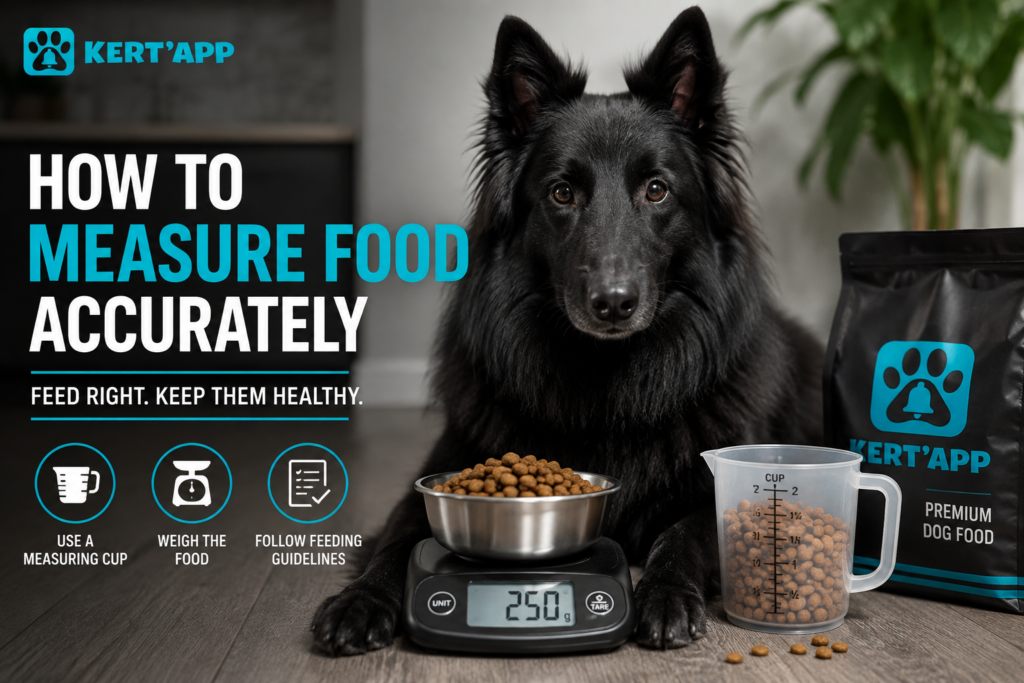
The most accurate method is weighing food on a digital kitchen scale. Check your food’s calorie content per ounce or per 100 grams, then calculate precisely.
If your kibble provides 380 calories per cup and you weigh that cup, you’ll learn exactly how much kibble equals those calories. Then you can weigh portions consistently going forward.
Cup Measurements Work, But Vary By Food
If using a standard measuring cup, scoop kibble into a level cup. Don’t pack it down. This is less precise than a scale but more practical for daily use.
Understand that different kibble shapes and densities pack differently. Small kibble pieces pack more densely than large pieces. The same cup might contain different calorie counts depending on kibble type.
Account for Treat Calories
Treats should be less than 10% of daily calories. A dog needing 1,000 calories daily should get fewer than 100 calories from treats.
If treats account for more, they’re often the reason for weight gain. Many owners are shocked to learn their dog’s training treats and table scraps total 300+ calories daily.
Best Feeding Practices and Techniques
Beyond just portions, how you feed matters significantly.
Meal Frequency by Age
Puppies (8 weeks to 6 months): 3-4 meals daily Puppies (6 months to 12 months): 2 meals daily Adult dogs (1-7 years): 1-2 meals daily (twice daily is more common and healthier) Senior dogs (7+ years): 1-2 meals daily (some do better with 3 smaller meals)
Most veterinarians recommend twice-daily feeding for adult dogs. It keeps metabolism steady, reduces gastric distension risk, and maintains stable energy throughout the day.
Feeding on a Schedule
Free-feeding (leaving food out all day) works for some dogs but tends to enable overeating. Scheduled feeding,offering meals at specific times, removing uneaten food after 15-20 minutes,gives you better portion control.
Scheduled feeding also helps with housetraining puppies (you know when they’ll need bathroom breaks) and helps you notice if your dog’s appetite changes, an early sign of illness worth staying on top of with veterinary reminder software so a follow-up vet visit doesn’t slip through the cracks.
The Benefits of Slow Feeder Bowls
Some dogs inhale their food, which can lead to:
- Choking
- Bloat (especially in large breeds)
- Digestive upset
- Rapid fullness without satisfaction
Slow feeder bowls with raised nubs force your dog to eat more deliberately. Meals take longer, your dog eats less air, and they feel satisfied on smaller portions.
Many dogs fed in slow feeder bowls actually eat about 10-15% less because they slow down and feel fuller from the same volume.
Automatic Dog Feeders
Automatic feeders can help maintain portion consistency, especially if multiple people are feeding your dog- pet sitters are exactly that scenario. . Programmable models portion out meals at specific times. Pairing a feeder with one of today’s pet health tracker apps makes it easy to keep portions, weight, and feeding times logged in one place instead of relying on memory.
They’re particularly useful for dogs with portion control challenges. The feeder guarantees portions remain consistent, preventing the creeping overfeeding that happens when different family members eyeball portions.
Frequently Asked Questions About Dog Feeding
How many calories does a dog need per pound of body weight?
The basic formula is 25-35 calories per pound daily, with the specific number depending on your dog’s age, activity level, metabolism, and health status. This is a starting point,individual dogs vary significantly.
A sedentary senior dog might need only 20 calories per pound, while an active young dog might need 40. Use this formula to estimate, then adjust based on how your dog actually maintains weight.
How much food should a 50-pound dog eat?
A 50-pound moderately active adult dog typically needs 1,250-1,750 calories daily. If your dog food contains 380 calories per cup, that’s roughly 3-4.5 cups daily, split into two meals.
But this varies dramatically. An extremely active 50-pound Border Collie might need more; a sedentary 50-pound Bulldog might need less. Adjust based on your individual dog’s body condition and weight stability.
How much do you feed a large breed puppy to avoid joint issues?
Feed large breed puppies at the conservative end of caloric recommendations,about 25-30 calories per pound of current body weight. Use large-breed-specific puppy formulas with controlled calcium and phosphorus levels.
Growth plate damage from excess calories during puppyhood causes orthopedic problems lasting your dog’s entire life. It’s not worth the risk of overfeeding for faster growth.
Do puppies eat more than adult dogs of the same weight?
Yes, significantly more. A 20-pound puppy might need 800-1,000 calories daily while a 20-pound adult needs 500-700. Puppies’ bodies are burning calories for growth plus activity. They also need different nutrient ratios,more calcium, and different protein levels.
This is why puppy formula is essential, not just puppy-sized portions of adult food.
How much should I reduce food for weight loss?
Start by reducing portions by 10% and reassess after 3-4 weeks. If your dog needs more weight loss, reduce by another 5-10%. Don’t cut more than 25-30% from their baseline, as that’s too restrictive.
Target weight loss of 1-2% of body weight weekly. For a 100-pound dog, that’s 1-2 pounds weekly,slow but sustainable.
Should I feed my dog more in winter?
Dogs spending significant time outdoors in cold weather do burn more calories maintaining body temperature. If your dog spends several hours daily outside in winter, you might increase calories by 10-20%.
However, most household pets spend minimal time in actual cold weather. Their indoor living uses similar calories year-round. Actual cold-climate working dogs benefit from increased calories; suburban pets probably don’t.
Is it better to feed dogs once or twice daily?
Twice daily is generally better for adult dogs. It maintains steadier energy levels, reduces gastric distension risk (especially important for large breeds prone to bloat), and helps you monitor appetite changes indicating potential illness.
Puppies need three to four meals. Senior dogs sometimes do better with three smaller meals if their digestion is declining. But for most healthy adults, twice daily works well.
What can I feed my dog to make their coat fuller?
A healthy coat starts with proper nutrition. Omega-3 and omega-6 fatty acids are essential,fish-based proteins and supplements provide these. Protein quality and quantity matter,your dog needs adequate high-quality protein.
Biotin, zinc, and vitamin A support coat health. Rather than adding random supplements, choose food with quality ingredients and ask your vet about targeted supplementation if your dog’s coat seems dull despite good diet.
How much raw food to feed a dog by weight?
The general rule is 2-3% of body weight daily for adult dogs. A 50-pound dog would eat 1-1.5 pounds of raw food daily. This is higher than kibble portions because raw food has more moisture and less processing.
Raw feeding requires careful food safety practices and balanced nutrition. Work with a veterinary nutritionist to ensure your raw diet includes appropriate calcium, phosphorus, and micronutrient ratios.
Is fresh dog food better for weight management?
Fresh, whole-food based diets are often more nutrient-dense and digestible than highly processed kibble. Some dogs do lose weight more easily on fresh food at the same calorie level because they feel more satisfied.
However, “fresh” doesn’t automatically mean lower calorie. Calorie content is what matters for weight loss. A fresh food diet at 500 calories per serving isn’t inherently better for weight loss than kibble at the same calorie level.
How much food should a 65 pound dog eat ?
65-pound pup typically needs around 1,625 to 2,310 calories daily, depending on how active they are. That’s roughly 3-4.5 cups of kibble per day, split into two meals. The real trick? Feel their ribs, if you can feel them easily but can’t see them sticking out, you’re feeding just right. Every dog’s metabolism is different, so adjust portions based on how your individual dog maintains weight.
How much should a 90 pound dog eat ?
A 90-pound dog needs approximately 2,250 to 3,150 calories per day, which usually works out to about 6-8 cups of kibble daily (split into two meals). That said, there’s no one-size-fits-all answer since factors like activity level, metabolism, and age all play a role. The best approach is to start with this range, then watch your dog’s body condition and adjust portions accordingly. Your vet can help fine-tune if you’re unsure.
Final Thought
Feeding your dog correctly isn’t complicated, but it does require paying attention to your individual dog rather than following a one-size-fits-all approach. Every dog is unique. Every dog’s needs are different. Your job is to observe, adjust, and work with your vet to keep your dog at a healthy weight with abundant energy and health.
Those extra pounds your dog’s carrying? They’re not inevitable. That energy level could improve. That coat could shine brighter. Often, it all comes down to getting portions right for your specific dog.
Start with the formula. Observe your dog. Make small adjustments. And trust that you know your dog better than any feeding chart ever could.
Talk to your vet about what’s most common in your area, what fits your dog’s lifestyle, and whether a combination product makes sense for your household. It’s a short conversation that heads off a much longer and more expensive one down the line.