
There’s a peculiar anxiety that hits every dog owner at 2 AM, that nagging feeling that maybe your pup isn’t totally fine. You notice she’s sleeping more than usual. Your senior beagle seems a bit sluggish during walks. You wonder: is he just getting older, or is something actually wrong?
This is exactly where a dog health tracker changes everything.
I’ve spent the better part of this year watching pet owners navigate the overwhelming world of dog tracking technology. What started as simple GPS collars has evolved into sophisticated health monitoring systems that catch real problems before they become emergencies. And honestly? It’s remarkable technology.
The catch is knowing what you’re actually looking for. A dog health tracker isn’t just another gadget. It’s a legitimate health partner for your pet,one that tracks location, monitors vital signs, and flags concerning patterns before your vet even needs to see your dog walk through the door.
Let’s break down what actually matters.
What Makes a Dog Health Tracker Different from Basic GPS
Here’s where most people get confused. They see “GPS dog collar” and assume it’s just about knowing where Rover is when he bolts through the gate.
Wrong. Well, partially wrong.
A basic GPS collar tells you your dog’s location. That’s valuable, sure. But a real dog health tracker does something more: it watches your dog from the inside out while keeping tabs on the outside in.
Beyond Location Tracking
Modern GPS dog collars now include accelerometers, temperature sensors, and activity monitors that work 24/7. They track not just where your dog goes, but how your dog moves,the pace, the intensity, the patterns.
Think of it this way: your phone tracks your steps, right? It knows when you’ve moved from sitting to running, and it measures the effort. A GPS dog collar for dogs does the same thing for your pet. Your dog’s collar logs every bound, every rest period, every change in behavior.
The real magic happens when you stack this data over time. Sudden activity drops often signal illness. Restless sleep patterns might indicate pain. Temperature fluctuations could suggest infection.
Real Health Insights Your Vet Wants You to See
Here’s something that surprised me: most vets love when owners show up with dog health tracker data. Why? Because it gives them a week or two of baseline information before the illness actually shows up clinically.
A dog health tracker doesn’t replace your veterinarian,it supports them. It’s like showing your doctor a smartwatch log before your physical exam. You’re giving them context.
One owner I spoke with caught early signs of arthritis in her Golden Retriever three months before traditional symptoms appeared, purely because her dog’s activity patterns had shifted gradually in the tracked data. Her vet was able to start preventive care rather than treating an advanced problem.
That’s not speculation. That’s a dog health tracker actually working.
Pro tip: Keep your dog’s health data organized and accessible. If you’re using a pet health reminder software system, you can store this tracker data alongside your vet appointments and health notes for a complete picture of your dog’s wellness timeline.
src=”https://www.youtube.com/embed/jYjfOwgaX9E?si=kJUsovpilc_IH15P”
How Dog Health Trackers Work: The Technology Behind Protection
The technology underlying modern dog GPS trackers is honestly kind of elegant in its simplicity.
GPS Collar Accuracy and Range
Let’s start with the GPS component. Most quality dog GPS trackers work on cellular networks (not satellite, which requires manual checking). They ping your dog’s location every few seconds to a few minutes, depending on battery life priorities.
The accuracy? Most modern systems nail it within 10-15 feet in open areas. Cities with dense infrastructure can see slightly wider margins because cellular signals bounce off buildings. But you’re getting genuinely useful location data,good enough to track escape artists and find lost dogs.
Battery life varies, but modern dog GPS tracker options typically deliver 7-14 days on a single charge. Some sacrifice battery life for more frequent location updates (useful if your dog runs frequently). Others prioritize battery and update less often.
Health Metrics Dogs Actually Need (Heart Rate, Temperature, Sleep Quality)
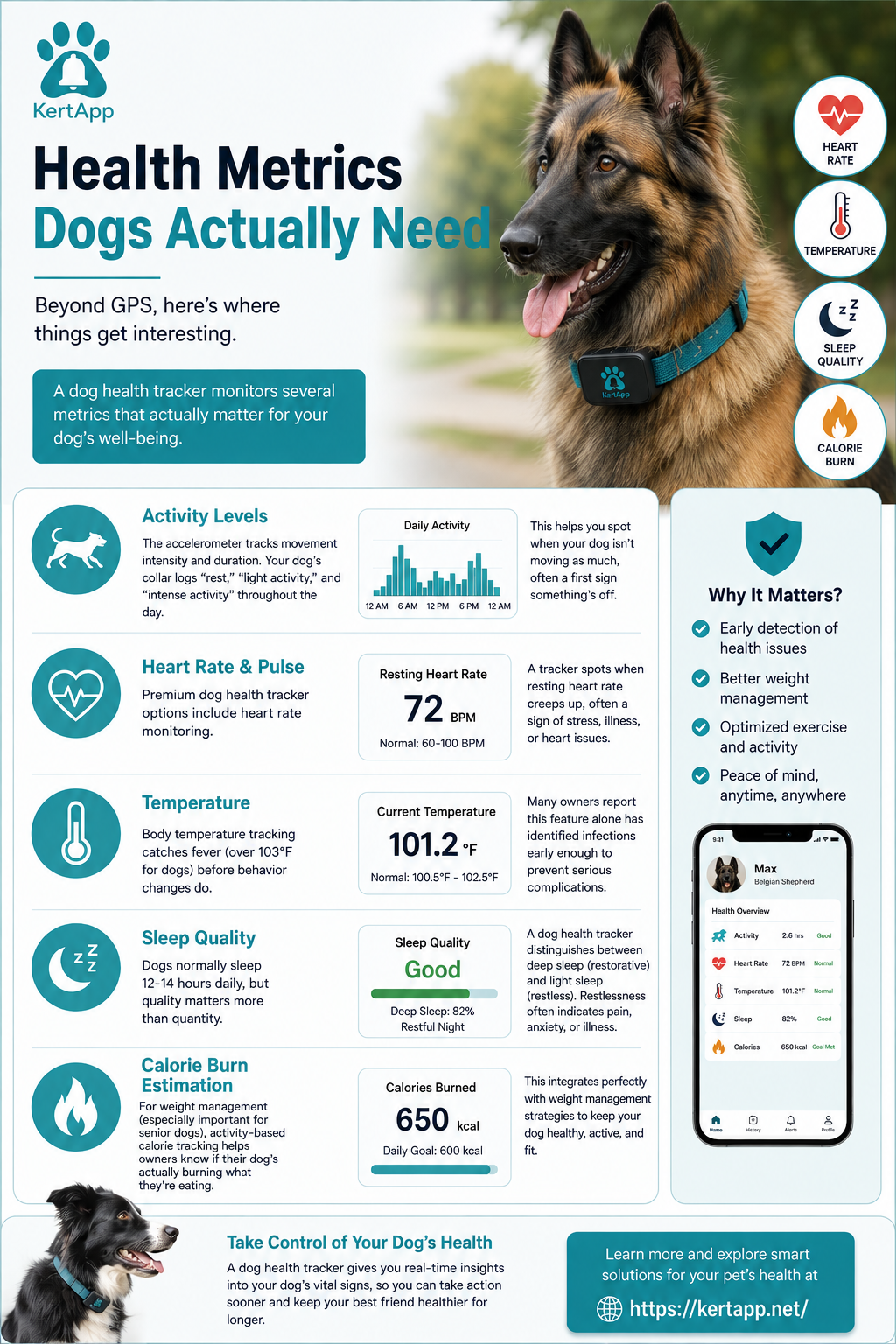
Beyond GPS, here’s where things get interesting.
A dog health tracker monitors several metrics that actually matter:
Activity levels: The accelerometer tracks movement intensity and duration. Your dog’s collar logs “rest,” “light activity,” and “intense activity” throughout the day. This helps you spot when your dog isn’t moving as much,often a first sign something’s off. If you’re monitoring your pet’s weight and health changes, activity data becomes crucial,it shows whether your dog is burning calories effectively.
Heart rate and pulse: Premium dog health tracker options include heart rate monitoring. Dogs typically maintain 60-100 beats per minute at rest (and up to 200+ during exercise). A tracker spots when resting heart rate creeps up,often a sign of stress, illness, or heart issues.
Temperature: Body temperature tracking catches fever (over 103°F for dogs) before behavior changes do. Many owners report this feature alone has identified infections early enough to prevent serious complications.
Sleep quality: Dogs normally sleep 12-14 hours daily, but quality matters more than quantity. A dog health tracker distinguishes between deep sleep (restorative) and light sleep (restless). Restlessness often indicates pain, anxiety, or illness.
Calorie burn estimation: For weight management (especially important for senior dogs), activity-based calorie tracking helps owners know if their dog’s actually burning what they’re eating. This integrates perfectly with weight management strategies discussed in our guide on tracking your pet’s weight and health changes.
Battery Life That Actually Lasts
Here’s the practical reality: a dog GPS tracker that needs charging every three days is basically useless. You’ll forget. Your dog will get unlucky in those off hours.
Modern systems designed specifically for pets handle this differently than human wearables. They use cellular GPS rather than constant satellite tracking (which drains batteries fast). They prioritize reporting intervals over constant monitoring.
Result: 7-14 days is realistic for most dog health tracker options. Some like Whistles go even longer. That’s usually enough to get through a typical week without constant charging anxiety.
Real Health Problems That Trackers Catch Early
This is where a dog health tracker stops being a convenience and becomes genuinely important.
Detecting Heart Issues Before Symptoms Show
Cardiac problems in dogs don’t announce themselves loudly. A dog with early heart disease doesn’t typically complain. Instead, subtle changes happen: resting heart rate gradually creeps up, activity levels slowly decline, sleep becomes restless.
Your dog health tracker catches all of these. You notice the pattern weeks before your dog would actually show obvious symptoms. Your vet catches it during a routine check and can start heart medication or management protocols early, when they’re most effective.
This isn’t theoretical. Animal cardiologists regularly mention that earlier detection changes outcomes significantly.
Spotting Illness Patterns in Your Dog’s Behavior
Sick dogs follow patterns. Lethargy increases. Appetite drops (shown through less excitement at mealtime, which affects activity). Sleep becomes chaotic,too much deep sleep as they recover, or restless sleep if something hurts.
A dog health tracker doesn’t diagnose. But it absolutely flags when your dog’s normal day doesn’t look normal anymore. That’s your signal to call your vet and say, “Something’s shifted,” rather than waiting until your dog is obviously sick.
Important: When you notice changes, use a tool like pet health reminder software to immediately schedule that vet appointment. Having your tracker data ready for your vet visit ensures nothing gets lost in translation about what you’ve observed.
Monitoring Sleep Quality for Senior Dogs
Senior dogs face a rough reality: joints hurt more, accidents happen more, recovery takes longer. Sleep becomes a window into their actual comfort level.
If your older dog’s sleep tracker shows an abrupt shift from solid sleep to constant restless shifting, that often means pain is increasing. Maybe arthritis flared up. Maybe something new is bothering them. Either way, you catch it and can talk to your vet about pain management adjustments.
Comparing Top Dog Health Trackers (Feature Breakdown)
This is where personal preference really matters. There’s no objectively “best” dog health tracker,there’s the best one for your dog.
If you’re researching options, our detailed breakdown of available pet health tracker apps provides side-by-side comparisons of the leading brands, features, pricing, and real user feedback.
Tractive GPS Tracker for Dogs vs. Whistle: Which Features Matter Most
Tractive focuses heavily on GPS accuracy and real-time tracking. If your dog is an escape artist, Tractive’s live GPS and geofencing features are excellent. Their health monitoring includes activity tracking and temperature sensing. Battery life runs around 5-7 days. Monthly subscription required.
Whistle emphasizes health tracking over pure GPS functionality. Their health metrics are more comprehensive,better activity classification, clearer health alerts. The battery lasts 7-14 days (better). Monthly subscription is also required, but often costs slightly less.
Pick Tractive if GPS accuracy is your priority. Choose Whistle if health monitoring takes the lead in your mind.
Monthly Fees vs. One-Time Costs (Breaking Down Pricing)
Here’s the reality: most quality dog GPS tracker options charge monthly. Figure $10-15/month for Whistle, $9.99-14.99/month for Tractive. That’s $120-180 yearly just for the service.
Some newer options (like Fi collar) charge around $150 one-time, then $6.50/month optional monitoring. Others include subscriptions in the hardware price.
For a dog health tracker, assume $100-250 for the device, then $100-180 annually for monitoring. If that feels expensive, consider: that’s often less than a vet emergency visit for detecting problems early.
Which Dog Tracker is Best for Weight Loss Monitoring
If your main goal is weight management, focus on calorie-burn accuracy. Whistle and Tractive both estimate calories burned through activity level classification.
For precise weight management, though, you’ll want a tracker that distinguishes between walking, running, and rest periods accurately. Whistles tend to be slightly more sophisticated here. Some trackers let you input food data directly for a complete picture.
Real talk: calorie tracking on pets isn’t as precise as human fitness wearables. Use it as a trend indicator, not an absolute number. For a complete weight management strategy, read our guide on the best way to track your pet’s weight and health changes.
Choosing the Right Dog Health Tracker for Your Situation
This is the part where I’d want you to really think about your dog and what matters most.
For the Anxious Escape Artist (GPS + Geofencing)
If your dog regularly bolts for freedom, you need a dog GPS tracker with reliable real-time location updates and geofencing alerts. Tractive excel here. Set a virtual boundary around your neighborhood, and you get instant alerts the moment your dog leaves it.
Battery life matters less here because you’ll charge religiously when your dog is an escape risk. Accuracy matters most. Tractive’s GPS is solid.
For Senior Dogs (Health Monitoring Focus)
An older dog benefits most from comprehensive health monitoring. You want sleep quality tracking, activity level trends, and temperature alerts. This is where Whistle shines.
Battery life also becomes attractive (fewer charge cycles for arthritic owners). Go for a dog health tracker that emphasizes health metrics over GPS. The peace of mind knowing you’ll catch pain or illness early is worth it.
For Active Dogs (Activity & Calorie Tracking)
High-energy dogs benefit from activity monitors that distinguish between different movement types. Some trackers are better at classifying “fetch” versus “walk” versus “run.”
Again, Whistle edges ahead here with more granular activity classification. If your dog is in serious training or sports, a dog GPS tracker with detailed activity logs helps optimize training and prevent overexertion injuries.
Budget-Conscious Pet Parents
Real talk: you don’t need the most expensive option. A solid dog GPS tracker at the $100-150 price point does everything most owners need. Look for 7-14 day battery life, basic health monitoring, and cellular GPS (not satellite).
Fi collar and some Tractive models hit this sweet spot without crushing your budget. Check our pet health tracker apps guide for budget-friendly options we’ve vetted.
Key Takeaways: What You Actually Need to Know
- A dog health tracker combines GPS location tracking with biometric health monitoring,it’s more than just knowing where your dog is.
- Modern systems catch early signs of serious issues (heart problems, illness patterns, sleep disruption) weeks before your dog shows obvious symptoms.
- Real dog GPS tracker options offer 7-14 day battery life with cellular-based location updates that work reliably in most environments.
- Pricing varies significantly: some require monthly fees ($9-15), while others offer one-time device purchases with optional subscription services.
- The best dog health tracker depends entirely on your dog’s age, activity level, and specific health concerns,there’s no single “winner.”
- Integration with your smartphone turns health monitoring from a “cool feature” into an “actual early warning system” for your pet’s wellbeing.
- Combine your tracker data with proper health documentation,use pet health reminder software to sync appointments, vaccines, and health notes.
Frequently Asked Questions
Can a Dog Tracker Detect Heart Failure or Joint Pain?
A dog health tracker won’t diagnose these conditions. But it will catch warning signs your vet needs to see. Elevated resting heart rate, reduced activity, and restless sleep all precede obvious heart or joint problems. You catch the pattern, you call your vet, and they can investigate with that context. That’s powerful.
How Accurate Are Dog Activity and Health Trackers Really?
Activity tracking is reasonably accurate (within 10-15% of actual activity). Heart rate sensors in pet wearables run about 90-95% accurate compared to clinical measurements. Temperature tracking is generally reliable. Sleep quality estimation is more interpretive,it’s a trend indicator rather than exact science. Bottom line: treat them as “pretty reliable” not “medical devices.”
What Is a Normal Resting Respiratory Rate for a Dog?
Most healthy dogs rest at 10-30 breaths per minute. Some trackers include respiratory monitoring,anything above 40 breaths per minute during rest can signal illness or pain. This is one metric where early detection has legitimately prevented serious outcomes.
Does the Fi Collar Track Health as Well as Whistle?
Fi collar focuses more on GPS accuracy and subscription flexibility (no mandatory monthly fees). Whistle’s health monitoring is more comprehensive. If you want the best health tracking, Whistle edges ahead. If you want the best GPS with optional health monitoring, Fi wins. Different strengths, different solutions.
What’s the Best Affordable Dog Health Tracker Under $50?
Truly comprehensive dog health trackers run $80-150 minimum. At under $50, you’re looking at very basic GPS trackers or previous-generation models. They work, but health monitoring features diminish. If the budget is tight, wait for sales or consider older models from respected brands over brand-new budget options. Our pet health tracker apps comparison includes budget-friendly picks.
How Do Dog Health Trackers Measure Sleep Quality?
Trackers use accelerometers to detect movement patterns. Periods of stillness = deep sleep. Frequent minor movements, light or restless sleep. It’s not perfect science, but patterns become obvious. A dog that normally sleeps deeply but suddenly shows constant restlessness might be in pain,that shift is what matters.
What’s the Most Durable Tracker for Hunting or Hiking Dogs?
Ruggedness matters here. Look for military-grade materials and true waterproofing (not just splash-resistant). Whistle and some Tractive models are built tough. Get a reinforced collar (not just the tracker on a standard collar). Your outdoorsy dog needs something that handles brush, water, and rough play.
The Real Value of a Dog Health Tracker
At its core, a dog health tracker isn’t about obsessive monitoring or unnecessary paranoia about your pet. It’s about shifting from reactive to proactive pet care.
Instead of waiting for your dog to be obviously sick, you catch patterns. Instead of wondering if age-related changes are normal or concerning, you have data. Instead of discovering serious health problems at an emergency clinic, your vet catches them during a routine visit.
That shift alone,from reactive to proactive,is why dog owners who use these systems talk about them with genuine appreciation rather than “nice to have” enthusiasm.
Your dog can’t tell you when something hurts. A dog health tracker does the telling for them.
Next Steps for Dog Health Tracking
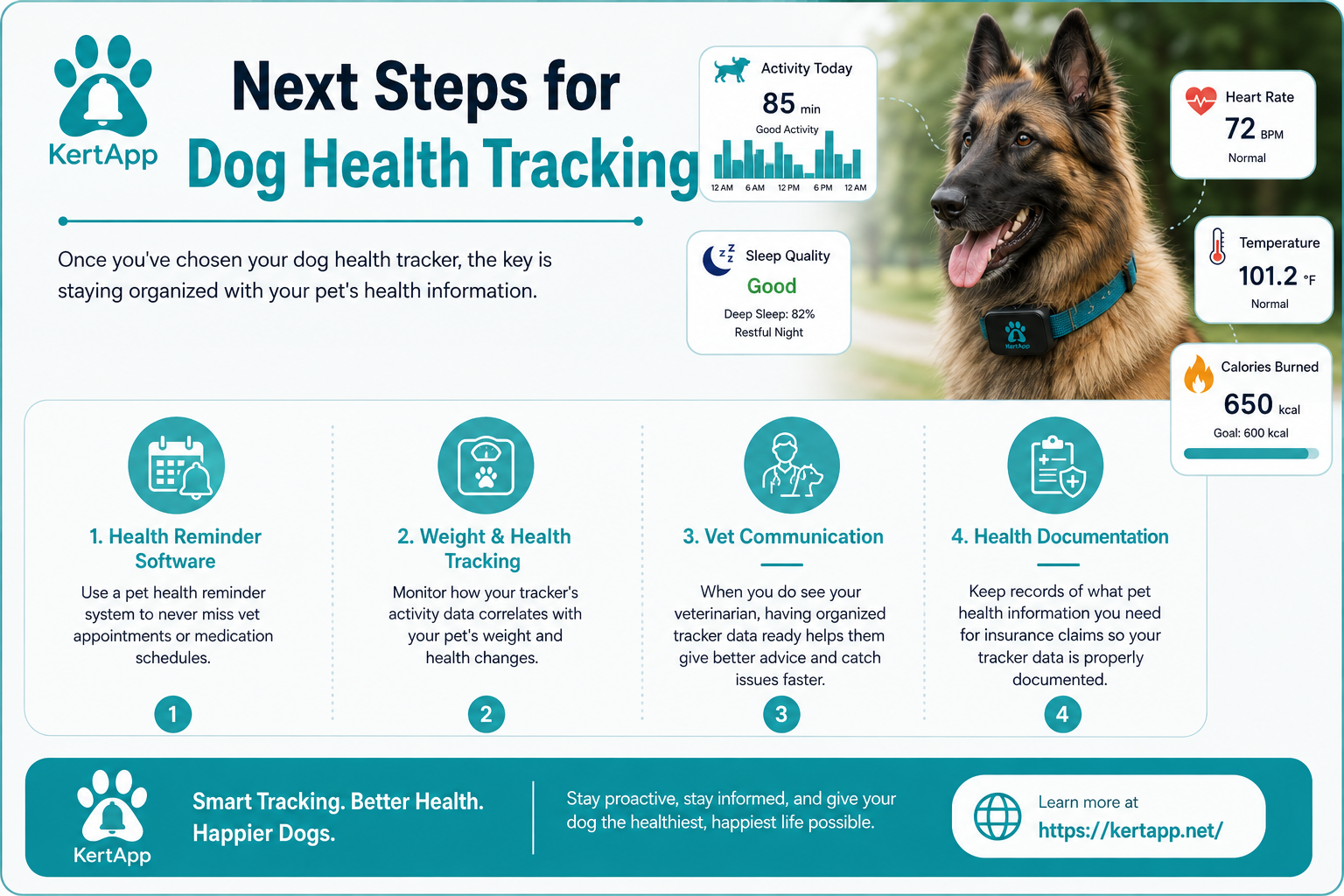
Once you’ve chosen your dog health tracker, the key is staying organized with your pet’s health information. Consider pairing your tracker with:
- Health Reminder Software : Use a pet health reminder system to never miss vet appointments or medication schedules.
- Weight & Health Tracking : Monitor how your tracker’s activity data correlates with your pet’s weight and health changes.
- Vet Communication : When you do see your veterinarian, having organized tracker data ready helps them give better advice and catch issues faster.
- Health Documentation : Keep records of what pet health information you need for insurance claims so your tracker data is properly documented.
The most successful pet owners treat health tracking holistically,combining device data with regular vet check-ins, proper documentation, and proactive health management.