
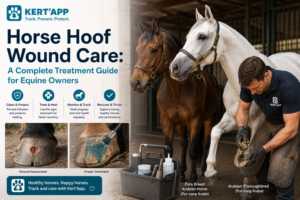
Your horse’s hoof is his lifeline – and a wound there demands immediate attention. This guide covers everything owners need to know about treating hoof punctures, separations, and infections. Learn how to clean wounds, prevent serious complications, and know when professional help is essential. We’ll walk you through the healing timeline and recovery expectations so you can help your horse bounce back faster.
THE STAKES ARE REAL – UNDERSTANDING HOOF WOUNDS
Equine hooves are a strange mix – tough enough to carry 1,000 pounds at a gallop, yet vulnerable to a stray nail in the mud. Your horse relies on his hooves for everything: movement, blood circulation, shock absorption, and staying comfortable. When something goes wrong with a hoof, it affects the entire horse.
I’ve watched owners panic when they find a puncture wound or notice their horse favoring a leg. That panic is understandable, but it’s important to remember this: most hoof wounds are treatable if you act quickly and stay consistent with care.
The hoof anatomy makes wounds particularly risky. The sole and frog are packed with nerve endings and blood vessels, but they’re not as well-protected as other parts of the body. Once bacteria enters through a puncture or cut, it can spread quickly in that warm, moist environment inside the hoof.
Think of it this way – the hoof is like a fortress with a few strategic weak points. A puncture can be a tiny hole on the outside, but bacteria can tunnel deep inside, leading to abscess formation or worse. That’s why knowing how to respond immediately makes a massive difference.
RECOGNIZING THE DIFFERENT TYPES OF HOOF WOUNDS
Not all hoof wounds are created equal. Understanding what you’re dealing with helps you decide between DIY care and calling the vet.
Puncture Wounds in the Sole
These are what most owners picture when they think “hoof wound” – something (a nail, a stick, a piece of fence wire) pierces through the sole. The concerning part? The object might fall out, leaving a hole that’s deceptively deep.
You’ll notice your horse holding the affected leg differently or showing obvious lameness. Sometimes there’s bleeding; sometimes there isn’t. The location matters – punctures near the frog or center of the sole are riskier than those at the edge.
Hoof Abscess (The Painful Buildup)
An abscess is what happens when pus accumulates inside the hoof. Sometimes it’s a result of a puncture wound; sometimes it develops on its own from bacteria entering through small cracks or thrush.
Your horse will be noticeably lame and reluctant to put weight on the foot. You might see heat radiating from the hoof or swelling above the coronary band. Some abscesses drain on their own; others need professional intervention to rupture safely.
Hoof Separation (White Line Disease)
This happens when the white line (the connection between the hoof wall and sole) separates and deteriorates. It looks like a gap or pocket forming where those structures should be attached.
White line disease is progressive – it doesn’t typically cause sudden lameness, but it gets worse over time. You’ll see the separation starting at the sole and working up. Prevention through proper hoof care is your best defense here.
Coronary Band Injuries
The coronary band is where new hoof tissue grows. An injury here is serious because it can affect how the hoof develops going forward.
This might look like a cut, puncture, or infection right at the hairline where the hoof meets the pastern. Lameness will be obvious, and there might be bleeding or discharge.
YOUR IMMEDIATE ACTION PLAN – WHAT TO DO RIGHT NOW
You’ve found the wound. Your heart’s racing. Here’s exactly what to do in the first few hours.
Step 1: Stop the Bleeding (If Present)
If you’re seeing significant bleeding, apply pressure with a clean cloth or gauze. Hold steady pressure for 10-15 minutes. Don’t peek under the cloth constantly – that disrupts clotting.
Most puncture wounds don’t bleed heavily since the hole is small and deep. If you do see substantial bleeding, call the vet immediately. That’s a sign something serious is happening.
Step 2: Clean the Wound Thoroughly
Use lukewarm water – not hot, not cold. Get a bucket and let the hoof soak for 15-20 minutes if possible. This softens the sole and helps you see what you’re dealing with.
Gently probe the wound with clean hands or a clean instrument to see how deep it goes. You’re looking for embedded objects, drainage, or signs of abscess formation. Don’t be aggressive – you’re investigating, not causing more damage.
Rinse away dirt and debris. Some owners use mild antiseptic solutions; plain water is often just as effective and less irritating.
Step 3: Identify What Caused the Injury
This matters more than you think. If a nail is embedded, you need to know how deep it went and what angle it entered. If it’s a puncture from a stick or stone, that’s different from a laceration.
Take photos if the wound is clear enough. These help the vet if you need to call one later.
Step 4: Assess Your Horse’s Response
Is your horse in severe pain or mild discomfort? Is he completely lame or just slightly favoring the leg? Can he stand weight on it at all?
Mild discomfort with minor punctures is normal. Severe lameness or refusal to bear weight suggests something deeper is going on – that’s a vet call situation.
ESTABLISHING YOUR DAILY WOUND CARE ROUTINE
Once you’ve handled the immediate crisis, it’s time to settle into consistent care. This is where most owners either succeed or fall behind.
The Soaking Protocol
Daily soaks are your foundation for healing. They keep the wound clean, encourage drainage, and soften the hoof so pus can drain naturally if an abscess is forming.
Use Epsom salt soaks – one cup of salt per gallon of water. Soak for 15-20 minutes daily, preferably in the morning and evening. This is non-negotiable if you want the best results. I know it’s time-consuming, but those soaks do the heavy lifting in your treatment.
Warm water is more effective than cold. If it’s winter or your barn is unheated, warming the water makes soaking more comfortable for your horse and more effective for treatment.
Poultice Applications
After soaking, many owners apply a poultice – a medicated paste that draws out infection and keeps the wound open for drainage. You have several options here.
Ichthammol (drawing salve) is a classic choice. Apply it thickly over the wound after soaking, then wrap. Some owners prefer commercially made poultices designed specifically for horses. The important part is that you’re creating a moist, encouraging environment for healing.
Change your poultice every 12-24 hours. Yes, that means twice-daily care at minimum. This is the commitment horse ownership sometimes demands.
Wrapping It Right
After poultice application, you need protection from dirt and debris. Here’s where proper wrapping technique saves you money and frustration.
Most owners use a combination of cotton, elastikon tape, and duct tape. The key is creating a wrap that’s protective but not so tight it cuts off circulation. You should be able to slide one finger under the wrap at the coronary band.
A basic wrap sequence: clean, dry the hoof, apply poultice, cover with non-adherent gauze, wrap with cotton, secure with elastikon, then duct tape the bottom and sides for waterproofing.
THE WRAP THAT STAYS ON – HOW TO MAKE A DUCT TAPE HOOF BOOT
You can’t soak in a muddy pasture. Eventually, your horse needs protection while still healing.
A duct tape hoof boot isn’t fancy, but it works. Start with a layer of duct tape, sticky side up, pressed firmly onto the sole. Add layers – you want thick coverage, about three layers minimum.
Wrap the tape around the walls of the hoof, securing it well above the coronary band. The goal is something that won’t slip off during turnout or work. Test it by pulling – if it moves, add more tape.
Some owners combine this with a regular hoof boot once the wound is healing well enough that you don’t need daily soaks. That gives your horse more normal movement while still protecting the sensitive hoof.
Change your boot or wrap every 3-4 days, or sooner if it gets wet or dirty. Each time you change it, you’re assessing how the wound is healing.
KNOWING WHEN IMPROVEMENT IS ACTUALLY HAPPENING
This is where most owners either get frustrated or lose focus – they can’t see dramatic progress, so they wonder if the treatment is working.
In the first week, you’re looking for reduced lameness (even slightly), less heat in the hoof, and any drainage decreasing. Don’t expect the wound to be “closed” yet. Open drainage is actually a good sign – it means infection is leaving the hoof.
By week two, lameness should be noticeably better. Swelling starts reducing. The hoof tissue around the wound might look red or raw – that’s normal. You’re seeing live tissue underneath, which is healing.
Weeks three through six, you’ll see real progress. The horse should be sound or nearly sound. Some swelling and sensitivity might remain, but it’s clearly improving. Return to light work is usually possible around week four for simple punctures. A lot of owners find it helps to log daily changes in weight, appetite, and mobility rather than trying to remember week-to-week whether things are actually getting better.
Full healing – where the wound has sealed and new hoof tissue has grown in completely – takes 6-8 weeks for uncomplicated punctures. More serious wounds take longer.
SERIOUS WOUNDS AND THE VET CONSULTATION
Not every hoof wound requires veterinary care, but some absolutely do.
Call the vet immediately if:
- The wound is extremely deep or you can’t see the bottom
- There’s severe bleeding that won’t stop
- The horse is completely lame and refusing weight
- You suspect joint involvement (obvious swelling above the hoof)
- The object is embedded in the frog or center of the sole
- There’s discharge with a foul smell (indicates deep infection)
- Your horse has fever or swelling up the leg
Call the vet within 24 hours if:
- The wound isn’t improving after 3-4 days of care
- Lameness is getting worse, not better
- Heat and swelling are increasing
- You’re unsure what you’re dealing with
The vet might recommend radiographs to check for foreign objects or bone involvement. They might prescribe antibiotics if infection is spreading. For serious cases, they might need to surgically open and drain an abscess. Between visits, setting reminders for follow-up checks keeps recovery on schedule instead of relying on memory during a busy barn week. It’s also worth saving vet records and receipts as you go, in case your insurance provider asks for documentation later.
There’s no shame in calling the vet early. They’re trained to handle these situations. It’s better to get professional assessment than to muddle through at home and end up with permanent damage.
PREVENTION – STOP THE PROBLEM BEFORE IT STARTS
Once you’ve dealt with one hoof wound, you’ll do whatever it takes to prevent the next one.
Regular hoof trimming matters more than most owners realize. A well-trimmed hoof, properly trimmed every 6-8 weeks, has balanced pressure distribution, better traction, and fewer stress points where injuries happen.
Clean, dry stalls make an enormous difference. Thrush and other fungal issues create weak points in the hoof. Proper stall maintenance prevents those problems from developing. If your horse is on wet bedding all day, his hooves weaken and become more susceptible to injury.
Drainage in pastures and paddocks matters too. A horse standing in mud all day isn’t going to have strong, healthy hooves. Good drainage and some dry turnout area are investments in hoof health that pay dividends.
Nutrition supports hoof strength from the inside. Adequate protein, quality minerals (especially biotin and zinc), and balanced omega fatty acids contribute to strong hoof wall growth. Feed matters more than many owners realize in the equation of hoof health.
Workload considerations are subtle but real. A horse doing intense work on hard ground will stress his hooves more than one doing light work on varied terrain. If your horse is doing demanding work, quality farrier care and supplementation become even more important.
THE HEALING TIMELINE – REALISTIC EXPECTATIONS
Different wounds heal at different rates. Understanding the timeline helps you stay patient and consistent.
Simple puncture wounds (uncomplicated, no deep infection): 2-4 weeks with daily care. Your horse should be sound enough for light work by week three.
Puncture with abscess formation: 4-8 weeks depending on severity. Once the abscess ruptures or drains, healing accelerates. The first week after rupture is critical – aggressive soaking and wrapping speeds recovery.
Sole bruising or corn development: 3-6 weeks. These are painful but usually heal well with rest and supportive care, and extension specialists note that a hoof tester can pinpoint the sore spot faster than guesswork.
Hoof separation (white line disease): 6-12 weeks or more. This is progressive and requires consistent farrier management. The damaged section must be trimmed away and new hoof tissue must grow in.
Deep wounds involving tissue or joint: 2-3+ months. These often require veterinary intervention and might involve radiographic monitoring. Some result in permanent structural changes to the hoof.
During this timeline, your horse needs rest. Light hand-walking is usually fine, but intense work delays healing. Think of hoof healing like bone healing – it requires time and protection.
WHAT ABOUT TOPICAL TREATMENTS?
You’ll see products marketed for hoof wounds – sprays, ointments, specialized horse hoof care products. Do they work?
Some do. Silver-based wound sprays have antimicrobial properties. Antibiotic ointments prevent infection. The reality is that the cleaning and consistent care matter more than the specific product you choose.
If you’re using a treatment, pick one and stick with it for at least two weeks. Constantly switching between products disrupts healing. Consistency beats perfection here.
Avoid treating with excessive antibiotic cream if you don’t suspect infection – sometimes less is more. Daily soaking and a simple poultice often outperform complicated medication protocols.
APPLE CIDER VINEGAR AND OTHER HOME REMEDIES
You’ll hear about apple cider vinegar for hoof health and other natural treatments. Do they work?
Apple cider vinegar has some antimicrobial properties, but it’s not a replacement for proper wound cleaning and care. If you want to try it, use it as a soak additive, not as your primary treatment.
Most serious hoof wounds benefit from the basics – clean water, Epsom salt soaks, poultices, and rest. Fancy treatments don’t beat fundamentals. If something sounds too good to be true, it probably is.
RED FLAGS THAT SUGGEST COMPLICATIONS
Not every wound heals smoothly. Watch for these warning signs that something’s gone wrong.
Increasing lameness after initial improvement – suggests abscess formation or spreading infection.
Foul-smelling discharge – indicates deep bacterial infection that needs intervention.
Swelling above the coronary band or up the leg – shows infection spreading beyond the hoof.
Fever or general illness – means the horse is developing systemic infection.
Absence of any improvement by day 10 – something isn’t working with your treatment approach.
Permanent swelling or sensitivity – might indicate scar tissue or structural damage requiring veterinary evaluation.
These aren’t always disasters, but they’re reasons to contact your vet and adjust your approach.
FAQ
How do you treat a puncture wound in a horse’s hoof?
Immediately clean and soak the hoof. Establish a daily routine of 15-20 minute Epsom salt soaks, poultice applications, and protective wrapping. Monitor for signs of abscess formation. If there’s no improvement within a week or lameness worsens, call the vet.
What is the best soak for a horse hoof abscess?
Epsom salt soaks are the gold standard. One cup of salt per gallon of warm water, 15-20 minutes once or twice daily. This draws out infection and keeps the hoof open for drainage. Some owners add drawing salve or poultice after soaking.
Can a horse recover from a hoof abscess?
Yes, most abscesses resolve with consistent care. Once the abscess ruptures or drains, healing accelerates significantly. Horses rarely have permanent lameness from a properly treated abscess, though some might develop minor sensitivity.
How long does it take for a horse hoof wound to heal?
Simple punctures typically take 2-4 weeks with daily care. Abscesses take 4-8 weeks. More serious wounds involving separation or deep tissue take 2-3+ months. Full hoof tissue regrowth takes longer than behavioral healing.
Should I call a vet for a horse hoof puncture?
Call immediately if the wound is deep, bleeding heavily, or affecting joints. Call within 24 hours if you’re unsure about severity or if the wound isn’t improving with home care. It’s always better to err on the side of caution.
How do you know when a hoof abscess is ready to drain?
The hoof becomes extremely hot, swelling increases dramatically, and the horse shows severe lameness. Some abscesses rupture on their own; others need professional intervention. According to University of Minnesota Extension, abscesses that keep draining more than 48 hours after starting, or horses that stay off their feed, need a vet’s attention rather than more home soaking.
What is the best duct tape hoof wrap technique?
Layer duct tape (sticky side up) three times on the sole, then wrap around the hoof wall above the coronary band, securing tightly. Test by pulling – if it moves, add more layers. Change every 3-4 days or when it gets wet.
Can you use apple cider vinegar for horse hoof problems?
Apple cider vinegar has mild antimicrobial properties but isn’t a primary treatment. It works best as an additive to soaks, not as a replacement for proper wound cleaning and care.
CONCLUSION
Horse Hoof wounds care are scary, but they’re rarely catastrophic if you respond quickly and stay consistent. Most horses recover completely with nothing more than daily soaking, wrapping, and patience.
The difference between a wound that heals cleanly and one that becomes complicated is usually owner diligence. Those daily soaks, the discipline to change poultices on schedule, the protective wrapping – these boring, repetitive tasks are exactly what save your horse’s soundness.
Your horse depends on you to stay calm, act decisively, and know when to call a professional. You’ve just gained that knowledge. Trust your instincts, stay consistent, and remember that most wounds heal beautifully with basic care.
your vet’s judgment always comes first on anything about treatment or when to escalate care. But for staying organized between visits, you can try KertApp for free and see if it fits how you manage your horse’s care. Got a question about setting it up for a horse specifically? Their team is easy to reach via the contact page.